How New IRDAI Motor Insurance Rules 2026 affect Car and Bike Owners?

Most of us don’t exactly look forward to renewing motor insurance. A reminder pops up, we open a few comparison sites, check the prices, and try to get it done before the policy expires.
Fair enough. Insurance paperwork is rarely anyone’s idea of a good time.
The problem is that when we buy in a hurry, we often know the price but not really what we’re getting for it. And that can come back to bite us later.
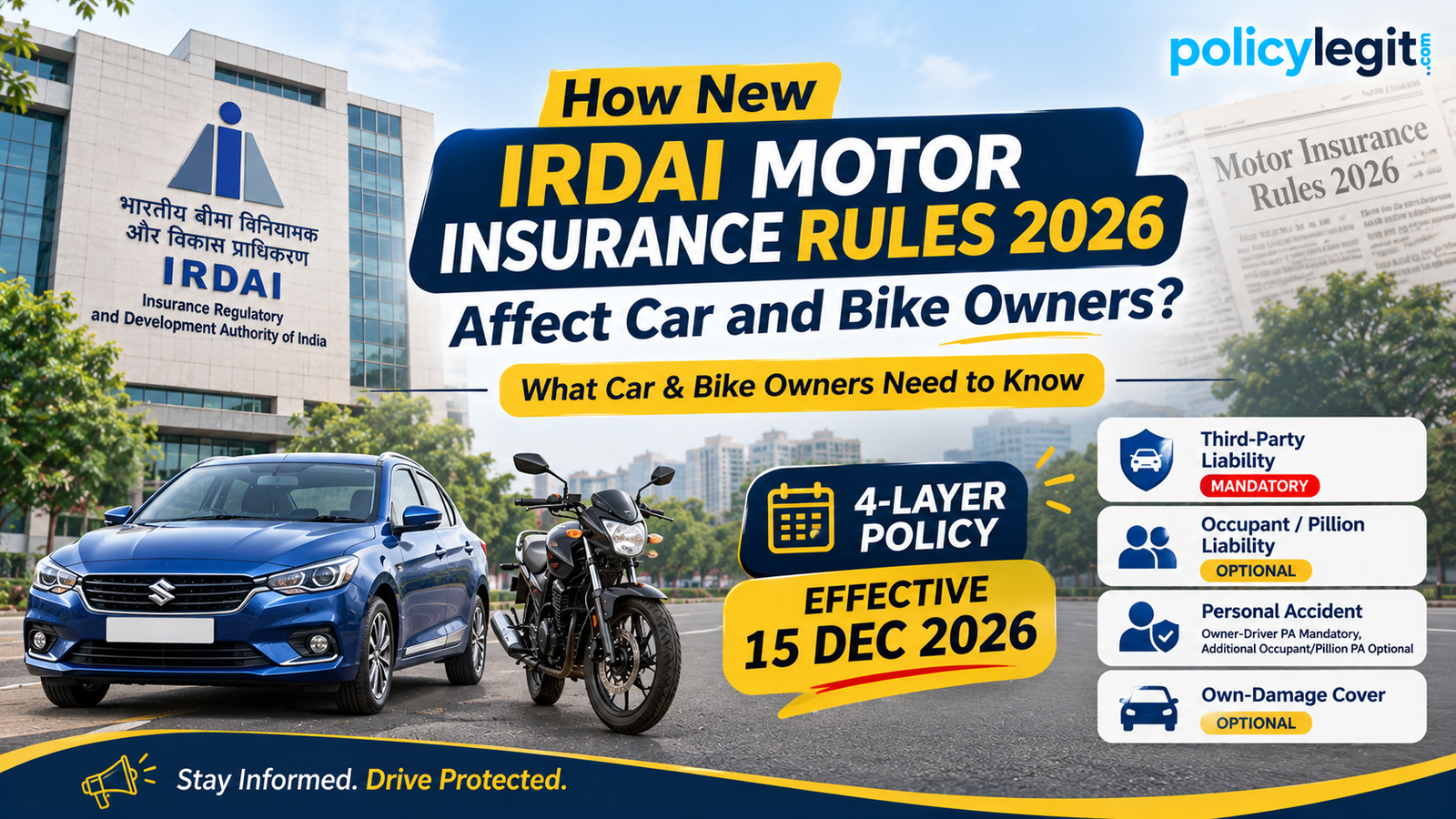
From 15 December 2026, IRDAI is changing how private car and two-wheeler insurance is structured. The different covers will be shown separately, so you’ll be able to see what’s compulsory, what’s optional, and how much each part costs.
This is worth understanding, especially if you’ve been auto-renewing the same kind of policy for years without looking too closely.
You may not need to buy more cover. But you also shouldn’t drop something important just because it looks optional and saves a bit of money.
Let’s break it down in plain terms.
First, what is this four-layer structure?
Until now, most buyers have thought about motor insurance in terms of two familiar choices:
Third-party insurance, the basic cover required by law. It protects against certain legal liabilities towards other people.
Comprehensive insurance, combines third-party plus cover for damage to your own vehicle.
That sounds simple enough. The confusion usually starts when you look at the smaller details: passenger protection, personal accident cover, own-damage claims and exclusions.
The new structure splits things into four main sections. Personal accident cover is further divided into two parts, so you’ll actually see five separate entries.
Section | What it covers | Status |
I | Liability to third parties | Mandatory |
II | Legal liability towards occupants or pillion riders, including employees | Optional |
III(i) | Personal accident cover for the owner-insured | Mandatory |
III(ii) | Personal accident cover for occupants, pillion riders and specified other drivers | Optional |
IV | Loss of or damage to your own vehicle | Optional |
This applies only to private cars and two-wheelers. Commercial vehicles are currently excluded.
What each section actually means in real life
Section I: Third-party liability
This is the part of motor insurance you cannot skip. Under the Motor Vehicles Act, a vehicle must have valid insurance covering third-party risks to be used on public roads.
But don’t expect it to pay for everything involved in that accident. What it doesn’t do is pay for damage to your own car or bike. A lot of people still get surprised by this.
Section II: Legal liability towards passengers
This is one section that deserves a closer look, particularly for people who rarely travel alone.
A passenger in your car or pillion rider on your bike is treated differently from someone outside the vehicle. This optional section deals with legal liability towards them. It also refers to employees of the insured.
It’s not the same as personal accident cover. That’s covered separately under Section III(ii).
Before selecting Section II, check who is covered, the limits and the conditions. Don’t assume that every person travelling in the vehicle is covered in exactly the same way.
Section III: Personal accident cover
This section has two parts:
- Section III(i): Owner-insured personal accident cover. It is mandatory and covers the owner-insured.
- Section III(ii) Personal accident cover for occupants and other specified drivers. It is optional and covers passengers, pillion riders, and certain other drivers.
Section IV: Own-damage
This is the section that many car owners will probably spend the most time considering. Own-damage cover protects your own vehicle against accident, fire, theft, and certain other risks.
Third-party insurance won’t take care of own damages bills. Without Section IV, you’ll generally have to manage that cost yourself.
So which covers should you actually take?
There’s no one-size-fits-all answer. It depends on your car’s age, how often you use it, who travels with you and your financial situation.
- You mostly drive for office commute: Your mandatory covers are still required. For the optional sections, consider how often you carry passengers and whether you could afford to repair or replace your car yourself.
- Your car is the family car: This is where I’d be particularly careful about the passenger-related covers. Think about the school run, grocery trips, weekend drives and visits to relatives. Someone is probably travelling with you quite often.
Read Section II and Section III(ii) carefully instead of assuming “comprehensive” already covers everything you need. - You ride a bike with pillion: This is common, but people don’t always think about the insurance implications.
Check both Section II and Section III(ii) for the pillion rider. - Your car is on finance: Don’t drop own-damage cover just because the insurance rules say it’s optional. Check your loan agreement first.
- Your car is 8–10 years old: The IDV is lower, so the premium may feel less attractive. Still, compare the actual numbers. An older car can still cost a lot to repair.
- You’ve just bought a new car: You may have spent a significant amount on the vehicle, and the thought of paying for major repairs yourself isn’t particularly appealing.
What if you take only the mandatory covers?
You can do that. You’ll have third-party liability and the owner’s personal accident cover.
What you won’t have is passenger liability cover, additional personal accident cover for others, or own-damage protection. If something happens to your own vehicle, you’ll generally be paying yourself.
Saving on the premium is fine. But saving a little on the policy can become an expensive decision later if you haven’t considered the risk.
Two documents you shouldn’t ignore
The new structure also brings two documents into the purchase process. They’re not just formalities.
- Customer Option Form records the covers you choose. Don’t just click through it. Check what you’re selecting and what you’re declining.
- The Customer Information Sheet (CIS) is meant to explain the available covers and important policy information.
Keep both documents with your policy papers.
Will it make insurance more expensive?
At this stage, no one can honestly say it will go up or down for everyone.
What will change is that the premium for each section will be shown separately. That should make comparison clearer, provided you actually look at what’s included, not just the final number.
When two quotes differ, check what is included in each one. A lower premium may simply mean that fewer optional covers have been selected. A higher premium isn’t automatically better either. Compare the protection first. Then compare the price.
I already have an insurance policy?
Your existing policy continues as normal. The new structure applies to policies issued from 15 December 2026 onwards.
There is one specific provision for people who already have third-party insurance. If you already have a third-party policy and want to add occupant liability (Section II), you can approach the same insurer, pay the extra premium, and get an endorsement. You don’t need to cancel the existing policy for this.
Buying a new car or bike? One more change you need to know
The Supreme Court also directed an increase in the duration of compulsory third-party insurance for newly purchased vehicles.
New private cars should get four years of third-party insurance (instead of three) and new two-wheelers six years (instead of five). This is separate from the four-layer structure and only applies to the third-party portion.
Check before you pay
Before completing your purchase or renewal, check these things:
- Vehicle details are correct
- Mandatory covers are included
- You understand the difference between the two passenger-related sections
- You’ve made a conscious decision on own-damage
- Section-wise premiums are shown
- You’ve received the Option Form and Customer Information Sheet
- The final schedule matches what you selected
If anything is unclear, ask before paying. It’s much easier to clarify at the buying stage than after a claim.
If you’re comparing car insurance options, take a look at the car insurance plans on PolicyLegit. Read the coverage details, compare the available options and take the time to understand the policy before you pay.
Frequently Asked Questions
- What are the new IRDAI motor insurance rules for 2026?
IRDAI has introduced a four-layer structure for private car and two-wheeler insurance. It separates third-party liability, occupant legal liability, personal accident protection and own-damage protection.
- From when will the new structure apply?
It will apply to policies issued from 15 December 2026.
- Does this change apply to commercial vehicles?
The circular covers private cars and two-wheelers. Commercial taxis, trucks, buses and other commercial vehicles should not automatically be treated as covered by this same structure.
- Is third-party insurance still compulsory?
Yes. Section I remains mandatory under the Motor Vehicles Act.
- Can I skip own-damage insurance?
Section IV is optional under the new structure. However, your lender may require own-damage cover under your vehicle loan agreement.
- What is the difference between Section II and Section III(ii)?
Section II deals with specified legal liability towards eligible occupants or pillion riders. Section III(ii) provides personal accident benefits to eligible occupants, pillion riders and specified other drivers.
- Will my existing policy be cancelled?
No. Existing policies continue according to their terms and validity. Policies issued from 15 December 2026 must follow the new structure.
- Can I add occupant liability cover to an existing third-party policy?
Yes. You can request Section II from the insurer that issued your existing third-party policy, by paying an additional premium. The additional cover begins at the date and time stated in the endorsement.
- What is the Customer Option Form?
It records the covers selected by the customer. The completed form must form part of the policy.
- What is the Customer Information Sheet?
It explains the available covers and important policy information. Insurers must provide it at the point of sale.
- Will premiums increase after December 2026?
There is no guaranteed increase or decrease for every buyer. The premium depends on the vehicle, insurer, selected covers, IDV and applicable pricing.
- Will new cars need four years of third-party insurance?
The Supreme Court directed that new private cars should have four years of third-party insurance, compared with the earlier three-year period. This is separate from the four-layer structure.
- Will new two-wheelers need six years of third-party insurance?
The Supreme Court directed that new two-wheelers should have six years of third-party insurance, compared with the earlier five-year period. This does not mean six years of own-damage cover is compulsory.